Ancient Egyptian dream interpretation

Well, proof-reading Scenes from a Life is going nicely, but it could hardly be called gripping work, however necessary it is. So in parallel with that I am going through the author’s notes section at the end of the book and filling in parts of that. One of the sections is on the way that ancient Egyptians interpreted dreams – which I find particularly interesting – so I thought I would copy chunks of it into a blog article.

Basically, the matter arises because the main character Makty-Rasut is rather shaken out of his comfortable life by a series of dreams, which are interpreted in part for him by a priest called Senenptah. Here is the current version of this part of the notes… The white sandals turn up in several of Makty’s dreams.

Egyptian dream interpretation sounds entirely random if you see the texts just in translation, but in the original language it makes far more sense. It was largely based on ideas of word-play – if you dreamed of one thing then the interpreter would think about other objects or situations that sounded similar or had similar verbal roots. There was also, as with dream theory in other cultures, a strong emphasis on identifying whether the situation would turn out as favourable or unfavourable for the dreamer. I have largely ignored this second strand of interpretation in Scenes from a Life, but in reality Senenptah would routinely be trying to ascertain from Makty’s dream accounts when an action should be taken or avoided to achieve a good outcome.

Now, interestingly, similar ideas are used in some modern schools of dream interpretation, especially those having a Jungian influence. In these, the unconscious processes active in dream sleep may well use word plays or visual puns to transfer meaning and significance to the conscious mind. So, hypothetically, dreaming of falling over – taking a trip – might suggest a journey, or even a drug experience.

Back with Makty-Rasut, the connection Senenptah makes between white sandals and a journey with auspicious conclusion is based on an actual dream text we have, specifically papyrus Chester Beatty III. This dates from less than a century before Makty’s time, and was found at the royal workmen’s village at Deir el Medina, on the west bank of the Nile opposite Luxor and so very close to Makty and Senenptah’s homes. It is currently in the British Museum. It contains a large number of single line interpretations, each of the form “If a man sees himself in a dream in [some situation] then: [interpretation]“. Each interpretation has a brief summary as either GOOD or BAD, followed by a brief explanation. The words GOOD or BAD are picked out in red ink rather than the normal black.

The relevant line of this text is “If a man sees himself in a dream shod with white sandals, BAD; it means roaming the earth“. Normally in Egyptian culture, roaming the earth would be perceived as BAD as it would mean being uprooted from the social network in which the person was embedded – family, friends, work, ancestral burials and so on. A journey would especially be seen as BAD if it involved travelling out of the Beloved Land (Ta Meri in Egyptian) as it carried the risk of having to be buried outside the land’s borders. In Makty’s case, the journey turns out to have a GOOD ending, but this is because of the particular circumstances of his life rather than normal ancient Egyptian thinking.

One of the several themes of the Egyptian poem The Tale of Sinuhe concerns the anxieties felt by Sinuhe himself and others who hear of his situation, at the thought of burial in a remote and rather uncivilised place. Likewise, one of the great motifs of his reconciliation and return to Egypt was the promise that a proper burial would be possible when the time came. The Tale of Sinuhe was composed several centuries before the setting of this story, but remained popular for many years, and copies have been found near Luxor, in particular at the workmen’s village.

The other word associations Senenptah makes for Makty are invented, but credible given the nature of the scheme of interpretation. Perhaps in time archaeologists will uncover an Egyptian text which confirms them! For example, when Senenptah asks Makty if he has seen a royal sceptre, or a large dish, the words used sound like (and are spelled very similarly to) words for Asiatic and north respectively. These sorts of clues would suggest to the priest that Makty was being directed by his dreams to travel north into the Asiatic province, here called the Kinahny lands. Many of the other details that are picked out in the dreams have a similar basis; others are just regular dream imagery that readers can enjoy deciphering for themselves.

All good fun… and a nice intermission from proof-reading!

All the Scenes from a Life are there!

Well, it’s true – just last night I finished the last sentences of Scenes from a Life. Of course, that is far from saying it is finished… for one thing I have to do my own read-through and catch as many of the little slips and errors as I can find. And get some external advice on this as well. And finish the author’s notes at the back, which will have a mixture of historical and textual notes including a paragraph or two on how ancient Egyptians interpreted dreams.

So there’s plenty to do yet, but this seems to me to be a good milestone to celebrate.

Other news – the Orangeberry tour continues with a guest post at Quality Reads UK. This was a brief look at how to present religious institutions in fiction – lots of people go down the route of large temples, structured hierarchy etc, but I wanted to capture something much less formal that would operate on a local village scale. The next event on the book tour is on October 1st.

I’m hoping to do a short series of more historically-oriented blog posts in a while, partly prompted by the very short guest posts I wrote for the blog tour. So look out over the next month or so for some bits and pieces on life in the second millennium… BC.

Book review – “The Blazing World” by Margaret Cavendish

Today’s blog is a book review, but unusually for me of a work by a long-dead author, Margaret Cavendish, Duchess of Newcastle-upon-Tyne (1623-1673). She published The Blazing World back in 1666, the same time that John Bunyan was serving a prison sentence for his beliefs and Samuel Pepys was writing about the Great Fire of London. I came across it in a list of seminal female science fiction writers which circulated on Google+. Nowadays it is available on kindle at a very reasonable price, and no doubt elsewhere as well, a fact that might well intrigue and amuse Margaret.

As I go on to say in the review, the book is not for readers who crave a fast-paced plot with regular cliff-hangers. Its concerns are very different from those of many modern authors. But as a window into the forward-thinking perspective of an older time, and as a precursor to much modern writing, it deserves better exposure. Happily, it is taught as part of some English literature university courses here in the UK, and available electronically to an interested modern reader. Long may this situation last!

Book Cover - Margaret Cavendish's Blazing World

==============The review===========

I first heard about Margaret Cavendish’s The Blazing World through a friend on Google+ and was intrigued. A female science fiction writer from the time of the Plague and the Great Fire of London? Since the kindle version is so extraordinarily cheap I had to follow this through, and am very glad that I did.

First though, let me say that not all readers will enjoy this book. It is, naturally enough, written in an older form of English in which many words do not have quite the same sense as today. The most obvious example is “artificial“. Today, if we see “artificial” in contrast to “natural” we tend to think that using “artificial” suggests that the thing is lacking in some way, clunky in comparison with the natural. But in the 17th century, it was used to indicate that something has been made by art, or artifice if you like, and so reveals something of ingenuity or creativity, as opposed to a raw product. A precious stone just out of the ground would be natural; the polished and shaped gem would be artificial.

Also, Margaret had no interest in fulfilling the plot expectations of some modern critics. Many things do happen, and I found the overall imaginative sweep gripping, but you won’t find a visceral cliff-hanger every few pages. Personally I liked this and it was a refreshing change from some of the formulaic modern material one encounters.

Finally, Margaret is just as interested – perhaps more so – in the philosophical shape of her world as the material one. There are descriptions of the physical layout of the Blazing World and how it might be accessed from our own. But there are also long sections in which one of the main female characters engages in intellectual debate with some of that world’s schools and learned institutions. Some of these are sympathetically presented, others plainly satirical, though you would have to know more than I about the intellectual landscape of her time to really appreciate the satire. It’s a bit like reading parts of Dante and trying to puzzle of why a particular person is being lampooned.

All in all, some modern readers would become impatient and frustrated with the book. For those who persevere with it, the gentle charm of the book draws you in. There is an inter-planetary war, and the invention of devices like submarines and torpedoes, but the real interest is in the intimacy of human contact, and the ultimate superiority of the world of the imagination over the world of external things. Particularly striking examples are “Why should you desire to be Empress of a Material World… when as by creating a World within yourself, you may enjoy … as much pleasure and delight as a World can afford you“, and again “if any should like the World I have made.and be willing to be my Subjects, they may imagine themselves such… but if they cannot endure to be Subjects, they may create Worlds of their own“. This theme increasingly comes to drive the narrative.

I became convinced as I read that modern authors such as Arthur C. Clarke have been influenced by The Blazing World. I was particularly reminded of the passage from 2001: “So almost certainly there is enough land in the sky to give every member of the human species, back to the first ape-man, his own private, world-sized heaven–or hell” – though in that case Clarke was thinking purely concretely in terms of stars in our galaxy, rather than imaginatively.

So five stars from me, along with a sincere wish that in whatever form Margaret might yet survive, she is able to receive modern appreciation of her work. This tale is not for everyone, certainly not for those who are impatient for a high-octane or erotically-charged plot, but personally I thoroughly enjoyed meeting this work and its author.

Orangeberry blog tour progress

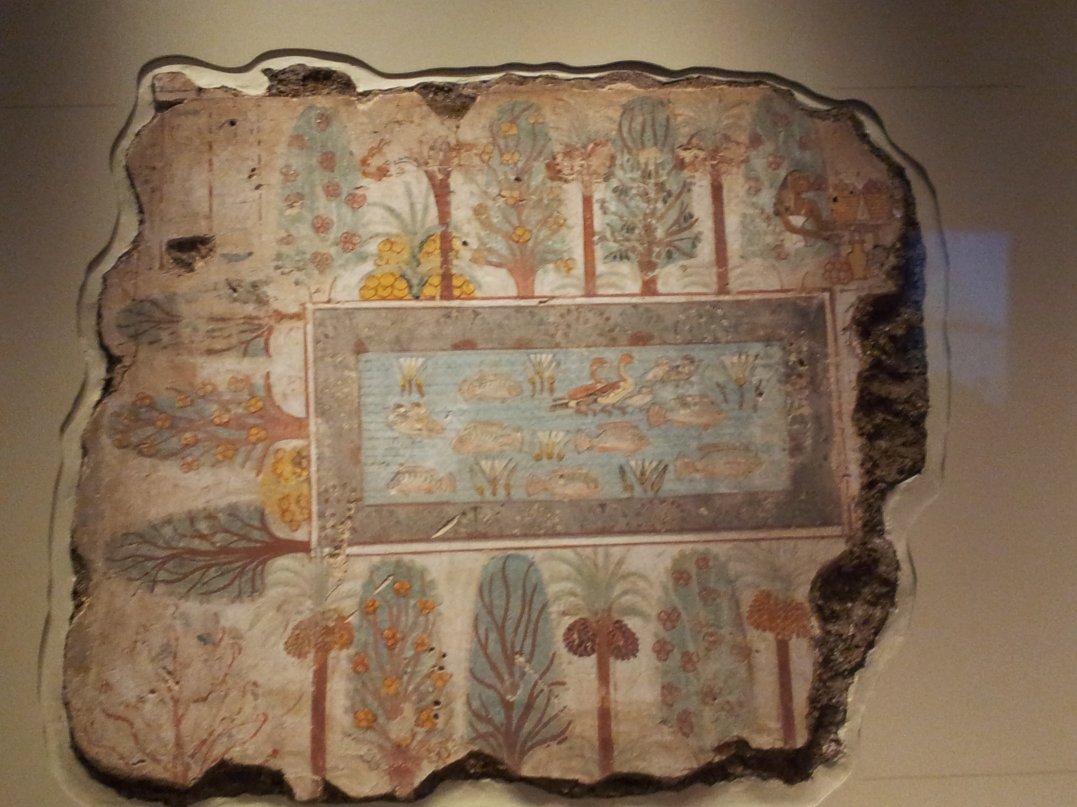
Well, the Orangeberry tour is a few days in and so far there has been a variety of posts and the like. Before listing those, here’s a quick snap from the British Museum today (apologies for the slight glass reflection to be seen). This rather charming scene is of Nebamun’s anticipated garden in the afterlife, and as well as trees, fruit, birds etc features a goddess figure leaning out of one of the trees (top right) offering food and drink to Nebamun.

Nebamun garden scene

Anyway, the list of blog tour activities so far is as follows:

Full details of future items may be found at http://www.orangeberrybooktours.com/2013/09/ob-summer-sizzle-richard-abbott/.

Enjoy!

On the London Underground

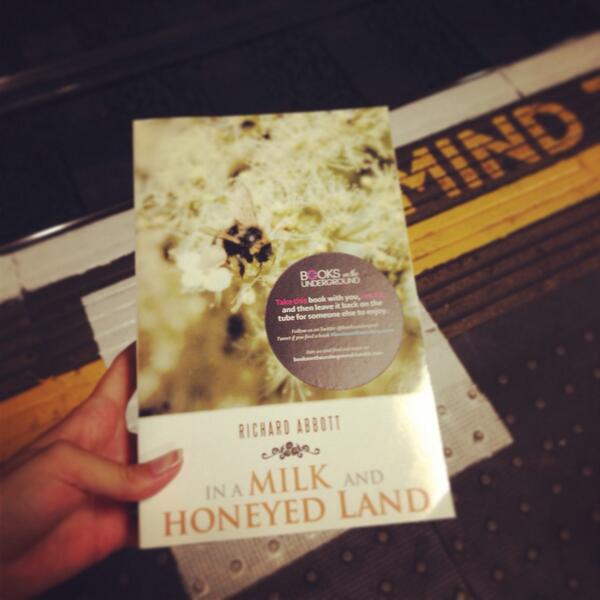
Those of you who regularly travel on the London Underground (as of course I do myself) could have a look out for two copies of In a Milk and Honeyed Land which are now part of the “Books on the Underground” scheme.

A copy of In a Milk and Honeyed Land being sent out

Check out booksontheunderground.tumblr.com for more details, or follow @BooksUndergrnd on Twitter.

In a Milk and Honeyed Land began its subterranean wanderings at Victoria this morning… hopefully I might get to hear of other sightings in time!

Catching up with things

OK, the last few days have been a catch-up time. For one thing I have posted up four reviews of books I read while away travelling. The simplest way to find them all is to go to http://www.kephrath.com/BookReviews.aspx and check out the most recent four items. There you will find a quick summary of them. Or you can go to each of Amazon, Goodreads and Shelfari and read the full versions.

The books were:

  1. The Patterns of Chaos, by Colin Kapp – an old science-fiction book I rediscovered,
  2. If Only You Knew, by Anastasia Abboud – a contemporary romance which I enjoyed for the centrally-important cross-cultural aspects,
  3. Skater in a Strange Land, by David Frauenfelder – a sort of cross-over science-fiction / fantasy book that mostly defies description but kept me reading avidly to the end, and
  4. The Ghost Bride, by Yangsze Choo – another cross-over, this time between historical fiction (1890s Malaya) and fantasy.

In just a day or so In a Milk and Honeyed Land is taking part in the oddly-named Summer Sizzle book tour – odd because over here at least the temperature has fallen well below sizzling! But check out the following link:
http://www.orangeberrybooktours.com/2013/09/ob-summer-sizzle-richard-abbott/.
There’s quite a schedule of blogs, reviews and what-have-you to follow over the next couple of months, with several events just in the next week. I’m sure there will be something for everyone in all of that.

There’s more to post on other subjects too, but that can wait for another day!

A quick update

I am on the move with only intermittent internet connection at present, so this is just a quick note. The gap has meant I have been able to have something of a read-fest so expect a little flurry of reviews before long.

I have also made great strides with the last parts of Scenes from a Life – the penultimate chapter is done, final chapter is now over half complete, and there are only a few odd bits here and there in earlier ones. I am almost at the stage of having a complete draft…

Meanwhile, here is a link to an animation of the contents of the British Museum Nebamun gallery – http://www.britishmuseum.org/explore/galleries/ancient_egypt/room_61_tomb-chapel_nebamun/nebamun_animation.aspx – Nebamun’s tomb dates from several generations before Scenes is set, but the content serves to inspire one of the central characters in his own work.