
Review – Prophet Motive, by John Bimson

The Prophet Motive, by John Bimson, is fundamentally about the narrow divide between understanding and misunderstanding. This swings from the minor and often hilarious slips which constantly hover in the background of English-American conversation, right through to the life- and world-threatening consequences of extremist interpretation of biblical prophecy.

The book was originally written with an expectation that the year 2000 would see an outbreak of millennial doomsdayism. As things turned out, this did not happen on a large scale, and even the excitement about the year 2012 – complete with feature film – was rather understated. However, The Prophet Motive can still be read as an echo of contemporary thought and preoccupation. Like so many former prophets, you just have to move the dates…

The book is undeniably funny, though with a very dry British sense of humour that some people may not click with. If you read it, be prepared to find serious subjects tackled in an offbeat way. The scenes towards the end, with multi-way puns on the word “seal” are something of a tour de force, and show up the military habit of thought as just as rigid and fundamentalist as the extreme religious group they confront. Conversely, if you cannot find humour and a sense of fun in tackling biblical prophecy, fringe views on the end of the world, middle eastern relationships, and archaeology, then this book is not for you. The position is summed up in the closing words, “Laughter… fosters self-critical detachment and has the power to defanaticise. I believe it is no coincidence that the Essenes of Qumran imposed penalties on members who giggled.”
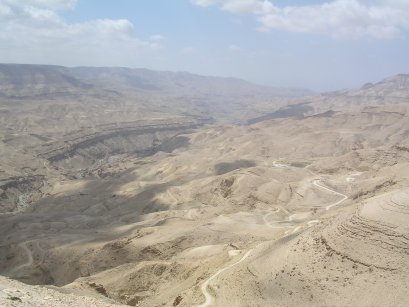
Arnon Gorge, Jordan

The primary technical vehicle for the plot is the investigation of the history of Israel in the couple of centuries before and after the time of Jesus. It is handled with skill and accuracy, including the state of Dead Sea Scroll research up to the time of writing the book (the late 1990s). The wide variety of motives that different people and groups have for looking at this period is captured, together with the whole spectrum of ability levels and preconceptions.

The book is very much plot driven, and only one or two of the characters change to any real degree from start to end. I did feel that the very last episode (Project Peter, Phase 2) was rather too easily dismissed as a non-event in favour of the climax of the personal quests of the two main characters. I suspect that Phase 2 was only really brought in for two reasons. First it takes the triumphal edge off the successful struggle against Phase 1. Secondly it allows a very cool snippet of humour turning the tables on the millenarianism that dominates the book. On balance, though, a potentially much more serious threat is casually discarded in a few words.

Sadly The Prophet Motive is currently out of print owing to the demise of the small press who took the project on, and at the time of printing no thought was given to electronic publication. It is to be hoped that this might change with the revolution in publishing which has happened in the last few years. Technically the book has been well proof-read and well edited, and I think it has good mileage in it still.

I really enjoyed this book, and think it would be accessible to a general audience. Certainly it helps already to know something about the areas tackled – the interpretation of prophecy, the nature of archaeological work and evidence, and so on. However, there are enough explanations along the way that if you did not know much about (say) the Dead Sea Scrolls beforehand, you will get to know what you need.

For me this was a four star book. I don’t often read fiction set in the present day, nor stories that are quite so plot-focused. So for me personally, the book missed a few elements which I look for. However, I would certainly recommend it as an exciting and entertaining read, and am very glad to have come across it. I suspect that people who are more familiar with this genre might rate it with five stars.

Finally, a disclaimer – John was my PhD supervisor a few years ago when I was working on Triumphal Accounts in Hebrew and Egyptian. However, that was long enough ago, and on a sufficiently different area of biblical and related studies, that I don’t feel this has compromised my objectivity at all.

Writing about religion

I have been wanting for some time to do occasional posts on the subject of religion in the second millennium BCE. Today’s post is a general start, loosely based on the rather short piece I did for the Orangeberry blog tour (Orangeberry book tour main page, or more specifically a guest post at Just My Opinion)

In that among other things I wrote

I enjoy writing about religion, or more exactly, I enjoy writing about people who have a religious faith. It is simply not possible to write about most ages of past human experience without including the religious life somewhere. Too often in books you come across a few very simple, and in my view quite unrealistic stereotypes. So there is the rabid fundamentalist, who reacts with violence to anything that seems to threaten his or her world view. Or there is the ruthless cynic, who knows it’s all make-believe and just wants to exploit others. Or there is the naïve villager, who is duped and never questions the wider system. Or there is the wise sage who holds to personal spirituality without the inconvenient trappings of any specific religion.

Now, I have at various times in my life mixed with and known people of faith who belong to various different religions, and I have to say that these simple pictures do not do justice to most of them. In terms of religious faith as well as other areas of life, people are more complex, and more interesting, than these stereotypes. They have doubt as well as faith, selfish as well as noble motives, mixed feelings about the religious institution they belong to, and, usually, commitment to a specific form of religion rather than a vague abstraction. They are often keenly interested in other forms of religion as well as their own, even if they think that those are ultimately incorrect.

Castlerigg stone circle, Lake District, England

For today I want to think about the many facets of religious life. The one which seems most obvious, judging from some of the books I read, is that of doctrine. I suppose it seems easy to quantify and approach, and is frequently used as s soft target by hostile writers: “these simple deluded folk really believe that the world was made from a discarded banana skin” or some such. For writers of a scientific disposition, it may seem a natural way to define a religion.

But many people who are spiritually inclined are well aware that this is a very small part of the religious life. In actual fact, doctrine is a serious intellectual pursuit and is frequently, in part, hard to follow. It also typically, in recognition that both the universe and the human organism are fantastically complicated things, has ideas and concepts which at first sight appear completely contradictory. The Egyptians, along with other peoples, were fond of this, making the quest for “Egyptian theology” quite a fruitless one. Some religious traditions have deliberately used these oppositional ideas to try to jog people out of complacency.

But more to the point, doctrine is not the centrally important thing to most religious groups that some writers present it as. To be sure, some groups place a very high store on sound knowledge, but still only as one facet amongst a much larger whole. In the Late Bronze Age world that I write about, doctrine is almost invisible. Readers will get very little sense of the details of Canaanite or Egyptian thinking from my books. The “favourite” goddess in Kephrath is Taliy, hardly one of the better known members of the Canaanite pantheon. Makty-Rasut, the main character in Scenes from a Life, expresses personal devotion to Seshat – again a figure that I suspect most people will need to use Google to learn about!

The second main area that you often find explored in fiction is spiritual experience; this typically gets a positive press, as it seems not specifically to tie in with the details of religion – “Trust your feelings, Luke”. It is certainly true that people recount their personal encounters with the numinous in very similar ways, regardless of their specific personal tradition. It is also true that these experiences are, seemingly, accessible to all, and evidence suggests that many, perhaps most people experience something of this at least once during their lives. Such experiences may be triggered by prayer or praise, but also by natural beauty, or sex, or moments of altruism. But equally, people who experience these moments more than just once in a lifetime have usually been involved with a particular religious tradition for a long time, and are thoroughly steeped in its particular disciplines and habits of thought. Even Luke has to disappear for an unspecified period of time to become trained and effective.

But there are other dimensions of religion which are often overlooked by writers. One is that of personal devotion. It seems attractive to some people to write about big temple ceremonies and lavishly dressed priests or priestesses – but in an agricultural world with no mass transportation, such pilgrimages must have been extraordinarily rare. Social classes below the elite may never have experienced them. For most people, the religious dimension of their life would be expressed in the home, or the village, with their families, friends, or next-door neighbours. Archaeological evidence and ancient texts support each other here, and we have strong evidence of household-level observance of rites and duties. I have equipped Kephrath with a high place, a small stone circle within and around which both religious and social events happen. We know that most settlements in the ancient near east had such arrangements of stones, though we do not know the details of how they were used. Today’s “community centres”, so important to isolated immigrant groups at risk of losing their identity after moving to a new nation, serve a similar purpose of blending religious observance and social need. In the absence of a dedicated religious building, the community centre serves as the focal point. Makty-Rasut, in Scenes from a Life, has a small statue of Seshat that he carries with him as a personal focus for prayer and devotion wherever he is living.

And this brings me on to the final dimension of the religious life for today – the social aspects. For many people in today’s world, in many different religions, social dimensions are in fact the most important ones that define their identity. Many Jews, Christians, Moslems, Hindus, Buddhists, and so on find their main experience of religion in the intricate web of the society around them. Huge numbers of people now and in the past have identified their religion not by rational assent to a doctrine, nor by vivid personal experience, but by the intimacy of their social network, and the place they and their family hold within it. The shape of a society (or a sub-group within society) is fashioned as an expression of religious commitment. Professor Dunbar has written of the cohesive effect of religion within human society (see for example a presentation he gave at a debate on race, religion and inheritance) – and also questioned whether this can or should continue in the future. That is a subject for another post – for today it is enough to recognise the central place of social interactions within people’s religious life. One of the central difficulties Makty has to face, though he does not really know how to articulate this, is how to step outside his familiar social circle into a different world. His statue of Seshat serves as a link back to the world he has known.

Enough for today – in a while I shall be writing about how religion changed between the second millennium Bronze Age and the first millennium Iron Age.

Another stop on the blog tour

Just a quick post tonight, with more to come later in the week hopefully.

The latest blog tour stopover is a guest post at http://www.aspiringbook.com/2013/11/writing-about-past-richard-abbott.html. The topic is “Writing about the past” and is a brief foray (via Star Trek) into the delights of writing creatively within a set of boundary conditions. In the case of Star Trek, the boundaries are set by the franchise holder. For those of us who write historical fiction, the boundaries are the things that are known about the past!

I have also been working on a cover for Scenes from a Life and am so-so happy just now. Needs more work…

Dead Romans – a review

David Cord, author of Dead Romans, supplied me with a free pre-release kindle copy to review. Here it is…

Dead Romans, by David Cord, is set in a place and time that I did not know much about – Ephesus around 165 AD, at the end of the Parthian campaign conducted by Lucius while he was co-emperor with his father Marcus Aurelius. The immediate crisis is a particularly severe outbreak of plague, apparently brought back by the soldiers as they returned from further east.

The book gives every impression of being carefully researched, at both the wider political level and as regards the details of ordinary Ephesian lives. Even a brief search online will reveal something of the history behind the novel. This wide spectrum of background research supports, and is crucial to, the particular style of the book.

David has chosen to structure the book by showing us three very different perspectives on the same events. In this way, the same people, places and events adopt a quite different significance in each portion. A person who might be a powerful and intimidating figure to one of the three is a mere annoyance or irrelevance to another. The first protagonist is a local shepherd, the second is Lucius’ mistress, and the third, intermediate between these in social location, one of the city bakers who also has pretensions to be an author. Their lives intersect in various ways. I am very partial to the inclusion of several different voices within a book, and have not often come across this particular strategy for including them.

So this triptych effect worked very well as a structural device for me, and gave considerable depth to the presentation. The three individuals naturally had entirely different views on what was or was not important, and their varying positions in society are well described. One difficulty for some people might be that the story does not go very far beyond what you have learned after the first third. However, there is some advancement in the plot, and there are certainly new pieces of the jigsaw that are provided.

Each of the three is given a fairly plausible back-story, so that you as reader can see how their personal histories are driving their present-day actions. Reasonably enough for story purposes, each of them is somewhat unusual as a member of their class. They stand out as remarkable individuals who each try to push back the limitations of their social role.

There were some difficulties. The central section, focusing on Lucius’ mistress Panthea, relied rather too heavily for my preference on her sexual activities, which tended to be squalid rather than exciting. Her back-story provides a rationale for this, and to be sure she is a courtesan whose main attraction to Lucius was presumably her sex appeal. However, Lucius is presented as a sensitive individual who wants more than an athletic bed partner. Panthea herself is supposed to be multi-talented in languages, philosophy and the arts – which makes good sense for someone aiming to catch the eye of royalty. But her part of the story is overwhelmed by sex, and somehow loses sight of other facets of her self.

The final portion, following Aristides the baker and potential author, ends up rather blurring his life with that of his prospective literary patron. Towards the end of the book is was not very clear which of them was in central focus. However, Aristides has much more contact with the soldiers than the other two, and these encounters are handled very persuasively. He certainly emerges as a plausible figure.

On a technical level, the pre-release kindle file I was provided with had a number of quite serious flaws. However, both author and publisher have told me that these have been corrected in the release version. All being well, future readers will not be distracted by these. Taking this final piece of editing into account, I have not let these problems affect my opinion.

On balance, for me, this was a four star book. On the basis of imagination and background research, I have no hesitation in commending it to others. It is a good introduction into a rather lesser-known slice of history, and many of the people described, both major and minor characters, are convincing. However, I was not won over by the central portion dealing with Panthea. It felt to me as though her potentially fascinating contribution was rather flattened into a single, rather repetitive, series of movements. The book as a whole is definitely worth reading, especially for those, like me, who enjoy historical fiction that is not preoccupied with battle scenes. The details of daily life in Ephesus emerge well from these pages, and I am certainly glad to have read this book.